
The Atlanta Falcons and Saints didn’t just share a division; they shared a quarterback era. From 2008 through 2020, Drew Brees and Matt Ryan turned two annual meetings into a running argument about pace, precision, and how to win the middle third.
Whether it was the dome light at Mercedes-Benz Stadium or prime time in New Orleans, the matchup kept the same questions: Who owns early downs? Who steals a possession? Whose star turns one mistake into the headline?
The Set-Up: Two Offenses, Two Philosophies
The Saints under Sean Payton tilted toward space and sequencing—formation variety, pre-snap tells that became post-snap mismatches, and a quarterback who lived on timing.
The Falcons, first with Mike Smith and then Dan Quinn, leaned complementary football: protect the zone on defense, build a run/pass marriage on offense, and leave the fourth quarter to a quarterback who could manage leverage. The Brees–Ryan years made those philosophies collide twice a season, often with playoff positioning attached.
Early 2010s: Tight Margins and Prime-Time Turns

These were nights where three plays decided everything. Red-zone calls, third-and-medium, and one field-position swing determined outcomes more than total yards.
You could feel the rhythm: if Ryan protected early downs, Atlanta kept the call sheet open for play-action; if Brees found free access on quick game, the Falcons’ back seven had to play perfect angles to survive the fourth quarter.
2012: When Atlanta Bent the Arc
On a Thursday in November 2012, the Falcons’ defense ended Brees’s 54-game touchdown streak and picked him off five times in a 23–13 win. That result didn’t erase New Orleans’ era, but it re-centered the rivalry: takeaways travel, and even a precision offense can be forced into long fields when first down is lost.
Mid-2010s: Stars Shape the Middle Third
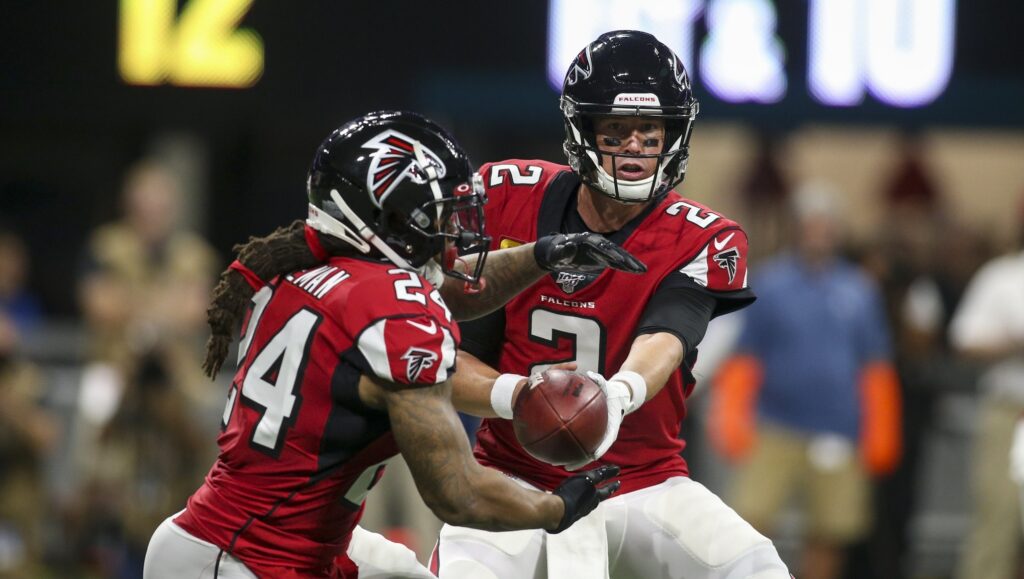
The cast turned over around the edges, but the spine stayed familiar. Julio Jones and Tony Gonzalez turned leverage into inevitability; later, Devonta Freeman gave Atlanta a downhill answer that protected play-action.
New Orleans cycled from Marques Colston to Michael Thomas, with Alvin Kamara adding angle-breaking yards after catch. The recurring lesson: the team that won early-count throws and denied the extra 90 feet (clean tackles, sure tags) usually owned the night.
Late 2010s: One Upset, Many Reminders
Records rarely mattered. In November 2019, a 1–7 Atlanta team sacked Brees six times and won 26–9 in the Superdome—proof that this rivalry ignores form and point spreads when one front controls protection and field position. It also reminded both sides that special teams and penalty discipline can tilt a quarter as decisively as any deep ball.
Why It Still Matters
The quarterbacks are different now, but the template remains. Falcons–Saints still tests early-down sequencing, protection rules, and whether a defense can disguise long enough to steal one possession without giving up two explosives. The Brees–Ryan years didn’t just make memories; they taught the habits both clubs still need to win in January.


