
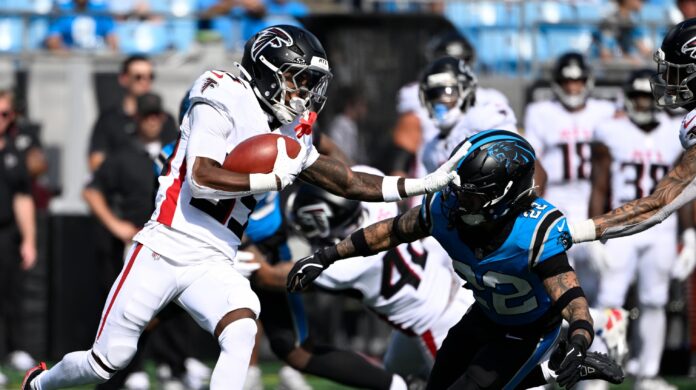
The Atlanta Falcons and Panthers don’t trade mythology so much as stress tests. Twice a year, Atlanta’s spacing-and-YAC personality meets Carolina’s edge-setting, pursuit-heavy profile.
In the dome light of Mercedes-Benz Stadium or the wind at Bank of America, the matchup reduces to rhythm: who owns early downs, who protects field position, and whose star tilts the middle third.
How It Became a Real Thing
Expansion made Carolina a neighbor; division realignment made the meetings routine; postseason stakes made them sticky. The Falcons’ timeline runs through Dan Quinn’s 2016 NFC title group and the earlier Mike Smith stability years.
Carolina’s arc peaks with Ron Rivera’s teams that won the conference in 2003 and 2015, when a defense built on range and leverage traveled anywhere.
The faces changed—Matt Ryan and Julio Jones giving way to Bijan Robinson and Drake London; Steve Smith Sr., Julius Peppers, and Luke Kuechly yielding to a new core—but the tension stayed: Atlanta seeks space; Carolina squeezes it.
What the Matchup Actually Tests

First down is the tell. When Atlanta wins it, the call sheet opens: play-action, formation shifts, and route craft that create free access throws and yards after catch.
When Carolina forces second-and-long, the game shrinks to protection rules and contested windows. Atlanta wants to convert explosives into control; Carolina wants to turn drives into a punt-and-pin tug-of-war where one mistake becomes the headline.
The Personalities, By Era
Falcons: From the Dirty Bird swagger through the Ryan–Julio peak to a present built on Bijan Robinson, Drake London, Kyle Pitts, and a front anchored by Grady Jarrett and A.J. Terrell, Atlanta’s best versions stretch the field without rushing. The blueprint under an organizational throughline: win the middle innings, keep the ball in front, cash mistakes.
Panthers: The Rivera years leaned complementary football: Cam Newton’s strain on edges, Jonathan Stewart’s downhill pace, and a defense that erased air with Kuechly’s range and Peppers’ length. The more Carolina compresses space, the more the game becomes theirs.
The October Barometer

The rivalry’s weight shows up when the calendar tightens. Atlanta’s 2016 NFC Championship (44–21 over Green Bay) was the year its spacing and explosive control scaled, with Jones and Ryan turning leverage into inevitability.
Carolina’s 2015 NFC Championship (49–15 over Arizona) was the model for defensive suffocation married to fast starts. Those chapters frame the modern bar these teams measure against.
Where It Turns on Sunday
- Early-Down Efficiency: Atlanta’s second-and-manageable vs. Carolina’s squeeze on the perimeter and play-action answers.
- The Extra 90 Feet: Clean returns, no free bases (penalties), and one relay that kills a rally.
- Star Moments, Middle Third: A contested ball to London, a backside cut from Bijan, or a Panthers edge win that forces a field goal instead of six.