
The Georgia Bulldogs don’t treat honors as décor. At Georgia, the difference between a banner and a standard is clear: retired jerseys mark the rare careers that rewired the program, and the all-sport Circle of Honor recognizes Bulldogs whose excellence and conduct define what the university expects across eras.
This explainer outlines what each honor means, who’s been recognized in football, and how to see it on a fall Saturday.
Retired Jerseys (Football): What It Takes—and Who’s Up There
Georgia retires jerseys sparingly. The threshold is generational: national awards, program-shaping production, and impact that still instructs coaches and players decades later. Those standards have produced four retired football jerseys:
- No. 21 — Frank Sinkwich (HB): Georgia’s first Heisman Trophy winner (1942), a two-way star whose speed and toughness set the program’s first national benchmark.
- No. 62 — Charley Trippi (TB): The do-everything threat of the 1940s whose versatility—running, passing, returning—still reads modern.
- No. 40 — Theron Sapp (FB): “The Man Who Broke the Drought,” his 1957 touchdown ended an eight-year winless run against Georgia Tech and became program lore.
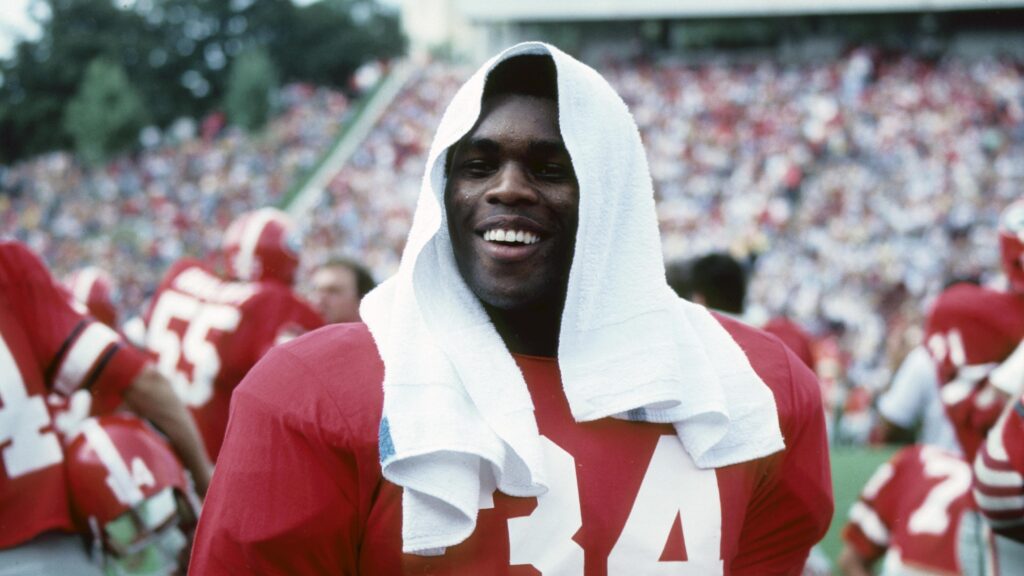
- No. 34 — Herschel Walker (TB): The template for dominance: SEC titles, a national championship, and the 1982 Heisman—production that reset what Georgia football could be.
A key nuance: Georgia retires jerseys, not numbers in the NFL sense. The honorees’ numbers are removed from circulation in football, but the university’s language emphasizes the jersey honor as the symbol of a career that stands apart. (The official Retired Georgia Jerseys roll is maintained by UGA Athletics.)
Circle of Honor: Georgia’s “Ring of Honor” Across All Sports
Where retired jerseys are sport-specific, the Circle of Honor is the Athletic Association’s highest recognition across all programs—think of it as Georgia’s university-wide ring of honor.
Inductees are former student-athletes and coaches whose performance and conduct brought lasting honor to UGA, with criteria that include earning a degree. Football figures are part of a long, cross-sport roster that also spotlights national champions and Hall of Famers in basketball, gymnastics, tennis, swimming, and more.
Recent classes have kept football present alongside other sports, underscoring how the Circle functions: it’s a museum-quality ledger of Georgia excellence that spans decades and disciplines, celebrated annually and often recognized at Sanford Stadium home dates. (UGA maintains a running Circle of Honor page with classes and criteria.)
How to See the History on Game Day

On a Saturday in Athens, the story shows up three ways:
- Inside Sanford Stadium: Look up from your seat and you’ll spot the names and numbers that frame the program’s narrative—those retired jerseys anchoring the football-specific pantheon.
- On campus and in displays: UGA’s athletics sites and in-venue presentations highlight Circle of Honor inductees throughout the year; classes are introduced at Sanford Stadium and honored formally in the West End Zone complex.
- In program materials: Game notes and history pages connect present tense to past legends—why those names are more than nostalgia and how they inform the current standard.
Why It Matters Beyond Memory
Georgia’s honors are practical as well as symbolic. Retired jerseys tell current players what “program-changing” looks like—production, toughness, and stakes.
The Circle of Honor widens the lens: the degree requirement and emphasis on conduct frame success as academic, athletic, and civic. Together, they explain why Sanford Saturdays feel both current and classical: the team is playing for the scoreboard and a lineage.